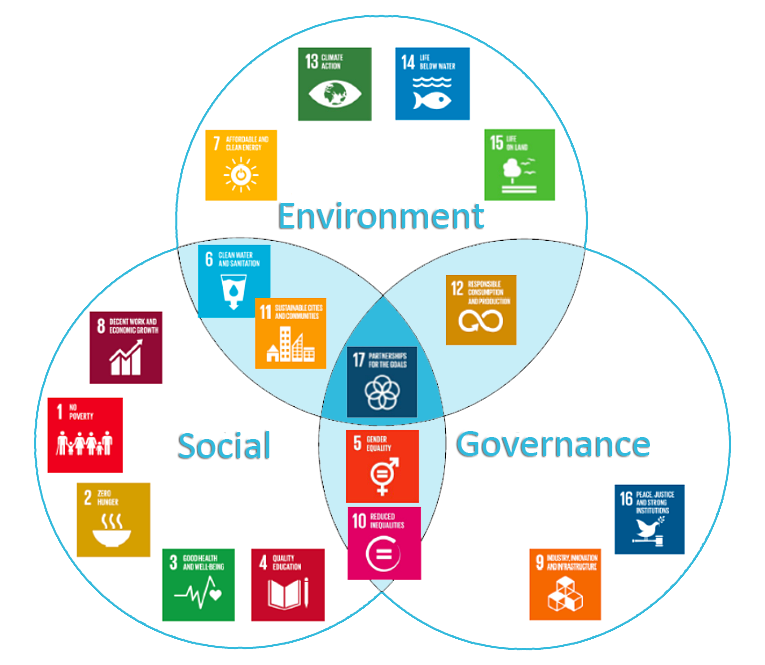
ESG and the SDGs: How They Work Together
Businesses are increasingly expected to understand and manage their effects on people, the environment and the wider economy. Two widely used concepts in this area are ESG and the Sustainable Development Goals (SDGs). They are connected, but they serve different purposes: ESG helps organisations assess and manage sustainability-related risks and performance, while the SDGs provide a shared global vision for sustainable development.
What is ESG?
ESG stands for environmental, social and governance. It is a broad framework used to consider how an organisation operates and how it manages issues that may affect its long-term performance and its impact on the world.
- Environmental: issues such as greenhouse gas emissions, energy use, pollution, waste, water and biodiversity.
- Social: matters including workers’ rights, health and safety, diversity, human rights, customer welfare and relationships with local communities.
- Governance: how an organisation is directed and held accountable, including board oversight, business ethics, executive pay, transparency and anti-corruption measures.
ESG is not a single universal standard. Organisations may use different reporting frameworks, measures and ratings, so results are not always directly comparable. It is therefore important to look beyond a headline score and understand what has been measured, how it was assessed and which issues are most relevant to the organisation.
What are the SDGs?
The Sustainable Development Goals are 17 goals adopted by United Nations member states in 2015 as part of the 2030 Agenda for Sustainable Development. They set out shared ambitions for addressing global challenges, including poverty, inequality, climate change, health, education and environmental protection.
The goals cover a wide range of areas. For example, SDG 5 focuses on gender equality, SDG 8 on decent work and economic growth, SDG 12 on responsible consumption and production, and SDG 13 on climate action. Together, they provide a common language for governments, businesses, charities and communities to discuss progress towards a more sustainable future.
How ESG and the SDGs are connected
ESG and the SDGs can complement one another. The SDGs describe broad societal outcomes, while ESG can help an organisation identify relevant issues, set policies, monitor performance and report on its actions.
For instance, a company seeking to contribute to SDG 13 may set targets to reduce its emissions. Its ESG reporting could then explain its emissions data, transition plans, governance arrangements and progress against those targets. Similarly, work on fair pay and safe working conditions may relate to SDG 8 and be reflected in the organisation’s social policies and performance measures.
Mapping activities to the SDGs can help explain how an organisation’s work relates to global priorities. ESG analysis can add detail about the organisation’s own risks, impacts and management practices. Used together, the two approaches can connect day-to-day business decisions with wider development goals.
Why the distinction matters
The SDGs are not, by themselves, a company rating system or a detailed set of corporate reporting requirements. Nor does referring to an SDG prove that an organisation has made a meaningful contribution to it. ESG, meanwhile, does not automatically show whether an organisation is helping achieve the SDGs. The usefulness of either approach depends on the quality of the evidence, the relevance of the measures and the honesty of the reporting.
Organisations should also distinguish between reducing harm and making a positive contribution. A business might support a project linked to an SDG while still having significant negative impacts elsewhere in its operations or supply chain. A credible approach considers both positive and negative effects, rather than highlighting only favourable examples.
Putting the frameworks into practice
A practical approach can begin with a clear understanding of an organisation’s operations, value chain and impacts. From there, it can:
- Identify relevant issues: assess which environmental, social and governance matters are most significant to the organisation and its stakeholders.
- Set meaningful priorities: connect those issues to relevant SDGs without claiming alignment where there is little evidence.
- Establish targets and responsibilities: assign clear ownership, measurable indicators and realistic timeframes.
- Track progress: use reliable data, explain methods and disclose setbacks as well as achievements.
- Review and improve: update plans as risks, evidence and expectations change.
Conclusion
ESG and the SDGs offer related but distinct ways to think about sustainability. The SDGs provide a global set of ambitions; ESG can help organisations examine and manage their own performance and impacts. When applied thoughtfully, they can support clearer priorities, stronger accountability and more useful reporting. Their value, however, depends on action and evidence—not simply on labels, commitments or attractive claims.
ESG and SDGs Explained: 8 Frequently Asked Questions on Sustainability in 2026
- Is ESG still relevant in 2026?
- How is ESG related to sustainability?
- What does SDG stand for?
- What is ESG in sustainable development?
- What is the difference between ESG and SDG?
- What is the importance of ESG in sustainable development?
- What does ESG stand for?
- What is difference between ESG and SDG?
Is ESG still relevant in 2026?
Yes, ESG remains relevant in 2026, but expectations are evolving. Organisations are increasingly expected to identify material environmental, social and governance issues, manage related risks and impacts, and support public claims with reliable evidence. Rather than treating ESG as a standalone score or communications exercise, businesses can use it to inform strategy, decision-making and transparent reporting, while linking relevant actions to the UN Sustainable Development Goals where there is a genuine connection.
How is ESG related to sustainability?
ESG is one way of assessing how an organisation manages issues related to sustainability. It covers environmental factors, such as emissions and resource use; social factors, including workers’ rights and community wellbeing; and governance, such as accountability and ethical conduct. Sustainability is broader, encompassing the long-term wellbeing of people, the planet and the economy. ESG provides practical criteria and measures that can help organisations understand, manage and report on their sustainability risks, impacts and progress.
What does SDG stand for?
SDG stands for Sustainable Development Goal. The term refers to one of the 17 goals adopted by United Nations member states in 2015 as part of the 2030 Agenda for Sustainable Development. Together, the goals address global challenges such as poverty, inequality, climate change, health, education and environmental protection.
What is ESG in sustainable development?
ESG in sustainable development refers to the environmental, social and governance factors used to assess how an organisation manages its impacts and long-term responsibilities. These factors include issues such as emissions and resource use, workers’ rights and community wellbeing, and ethical leadership and accountability. By measuring and improving its ESG performance, an organisation can help reduce harm, manage risks and support wider sustainable development priorities, including the UN Sustainable Development Goals (SDGs).
What is the difference between ESG and SDG?
ESG stands for environmental, social and governance, and is a framework for assessing how an organisation manages its impacts, risks and responsibilities in these areas. The SDGs, or Sustainable Development Goals, are 17 global goals set by the United Nations to address challenges such as poverty, inequality and climate change. In short, ESG focuses on an organisation’s performance and practices, while the SDGs provide shared goals for society as a whole. Organisations can use ESG measures to track their progress towards relevant SDGs.
What is the importance of ESG in sustainable development?
ESG is important to sustainable development because it helps organisations understand and manage their environmental and social impacts, while promoting responsible governance and long-term decision-making. By measuring issues such as emissions, working conditions and business ethics, organisations can identify risks, set meaningful targets and track their progress. This can support progress towards the UN Sustainable Development Goals (SDGs), although ESG reporting alone does not guarantee a positive contribution: effective action depends on credible data, clear accountability and measurable results.
What does ESG stand for?
ESG stands for environmental, social and governance. It describes three areas used to assess how an organisation manages its environmental impact, treats people and communities, and is governed. Environmental factors may include emissions and waste; social factors can cover workers’ rights and health and safety; and governance includes issues such as business ethics, accountability and board oversight.
What is difference between ESG and SDG?
ESG (environmental, social and governance) is a framework for assessing how an organisation manages its impacts, responsibilities and sustainability-related risks. The SDGs (Sustainable Development Goals) are 17 global goals set by the United Nations to address challenges such as poverty, inequality and climate change. In short, ESG helps organisations measure and manage relevant issues, while the SDGs provide shared goals they can contribute towards.