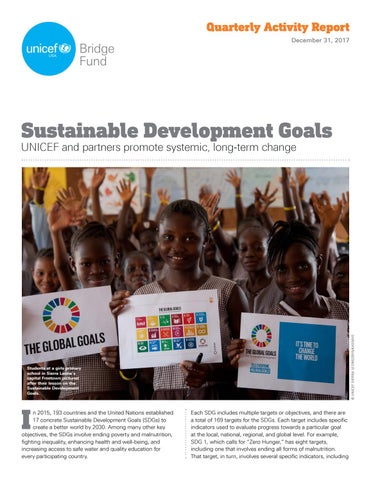
SDGs and UNICEF: Putting Children at the Heart of Sustainable Development
The Sustainable Development Goals (SDGs) are a shared plan for building a fairer, healthier and more sustainable world. Adopted by United Nations Member States in 2015, the 17 goals form part of the 2030 Agenda for Sustainable Development. They address challenges including poverty, hunger, health, education, inequality and climate change.
UNICEF—the United Nations Children’s Fund—works with governments, communities and partners to advance children’s rights and wellbeing. Its work is closely connected to the SDGs because children are affected by every aspect of sustainable development, and because progress for children helps create stronger, more resilient societies.
Why the SDGs matter to children
Several goals relate directly to children’s everyday lives. SDG 1 aims to end poverty, while SDG 2 focuses on ending hunger and improving nutrition. SDG 3 concerns health and wellbeing, and SDG 4 calls for inclusive, equitable, quality education. Other goals address clean water and sanitation, gender equality, reduced inequalities, safe communities and climate action.
These issues are interconnected. A child who lacks nutritious food may struggle to learn. Unsafe water can contribute to illness and missed school. Discrimination or conflict can make it harder for children to access healthcare and education. Progress therefore depends on joined-up solutions that respond to children’s needs as a whole.
How UNICEF supports progress
UNICEF’s work spans many areas reflected in the SDGs. Depending on the country and local priorities, this can include supporting childhood immunisation and maternal health, improving access to clean water and sanitation, promoting quality education, protecting children from violence and exploitation, and helping communities prepare for emergencies.
UNICEF also advocates for children’s rights and works with public authorities and other partners to strengthen services and policies. This includes paying attention to children who are most likely to be left behind, such as those affected by poverty, disability, displacement, discrimination or humanitarian crises.
Measuring progress—and recognising the gaps
The SDGs provide targets and indicators that help countries assess progress. Reliable data is essential: without it, the needs of children—particularly those in marginalised communities—can remain invisible. UNICEF contributes research, analysis and data on issues affecting children, helping governments and partners understand where progress is being made and where further action is needed.
However, a global commitment does not automatically lead to change in every community. Conflict, inequality, climate-related disasters and limited resources can slow progress. Even where national figures improve, some groups of children may still lack essential services. That is why progress needs to be monitored locally as well as nationally, with children’s experiences taken into account.
Working towards 2030
The SDGs set an ambitious agenda, but their success depends on sustained cooperation and investment. Governments have a central role, alongside international organisations, local communities, civil society and businesses. Children and young people also have valuable perspectives on the decisions that shape their lives and futures.
UNICEF’s connection to the SDGs reflects a simple principle: a sustainable future cannot be achieved while children are denied their rights or left without the support they need to thrive. By placing children at the centre of planning and action, countries can make progress towards the goals—and towards a safer, healthier and more equitable world for everyone.
UNICEF and the Sustainable Development Goals: Frequently Asked Questions
- What are the Sustainable Development Goals (SDGs)?
- What does UNICEF do to support the SDGs?
- Which SDGs are most closely linked to UNICEF’s work?
- How do the SDGs aim to improve children’s lives?
- How does UNICEF measure progress towards the SDGs for children?
- How does UNICEF help children affected by poverty, conflict or emergencies?
- What role do governments play in achieving the SDGs for children?
- How can young people contribute to the SDGs?
- What challenges are preventing the SDGs from being achieved by 2030?
What are the Sustainable Development Goals (SDGs)?
The Sustainable Development Goals (SDGs) are 17 shared goals adopted by United Nations Member States in 2015 as part of the 2030 Agenda for Sustainable Development. They aim to tackle global challenges such as poverty, hunger, poor health, inequality and climate change, while promoting education, peace and environmental protection. UNICEF supports progress towards the goals, with a particular focus on children’s rights, wellbeing and access to essential services.
What does UNICEF do to support the SDGs?
UNICEF supports the Sustainable Development Goals (SDGs) by working with governments, communities and partners to improve children’s health, education, nutrition, safety and access to clean water and sanitation. It also advocates for children’s rights, helps strengthen services and policies, and gathers data to show where progress is being made and which children are being left behind. This work contributes to several SDGs, particularly those focused on ending poverty and hunger, improving health and education, reducing inequality and protecting children in emergencies.
Which SDGs are most closely linked to UNICEF’s work?
UNICEF’s work is closely linked to all 17 Sustainable Development Goals, as each affects children’s rights and wellbeing. Its work has particularly strong connections with SDG 1 (No Poverty), SDG 2 (Zero Hunger), SDG 3 (Good Health and Well-being), SDG 4 (Quality Education), SDG 5 (Gender Equality), SDG 6 (Clean Water and Sanitation), SDG 10 (Reduced Inequalities) and SDG 16 (Peace, Justice and Strong Institutions). UNICEF also supports progress on goals such as climate action and partnerships, recognising that children’s needs are interconnected and that no single goal can be achieved in isolation.
How do the SDGs aim to improve children’s lives?
The Sustainable Development Goals (SDGs) aim to improve children’s lives by tackling the conditions that affect their health, safety and opportunities. They include targets on ending poverty and hunger, improving healthcare and nutrition, providing inclusive, quality education, ensuring access to clean water and sanitation, advancing gender equality and protecting children from violence. Because these goals are interconnected, progress in one area can support progress in others. UNICEF works with governments and partners to help turn these commitments into practical action, with particular attention to children who are most at risk of being left behind.
How does UNICEF measure progress towards the SDGs for children?
UNICEF measures progress towards the SDGs for children by analysing data against relevant targets and indicators, including information on health, education, nutrition, protection and access to essential services. It works with national statistical offices, governments and other partners to collect and assess data, identify which groups of children are being left behind, and track differences between regions and communities. UNICEF also publishes research and progress reports to highlight trends, gaps and areas requiring further action.
How does UNICEF help children affected by poverty, conflict or emergencies?
UNICEF helps children affected by poverty, conflict or emergencies by working with governments, communities and humanitarian partners to provide essential support, such as healthcare, nutrition, clean water, education and protection from violence and exploitation. During crises, it also helps deliver emergency supplies and services, support children who have been displaced or separated from their families, and restore vital services where possible. Its work aims to reach the most vulnerable children and uphold their rights, both during emergencies and as communities recover.
What role do governments play in achieving the SDGs for children?
Governments play a central role in achieving the Sustainable Development Goals (SDGs) for children. They are responsible for turning global commitments into national laws, policies and funded services, including access to healthcare, quality education, clean water, social protection and child safeguarding. Governments also collect data to track progress, identify which children are being left behind and work with organisations such as UNICEF, communities and young people to shape effective solutions. Their decisions on budgets and public services can help ensure that every child has the opportunity to survive, learn and thrive.
How can young people contribute to the SDGs?
Young people can contribute to the Sustainable Development Goals (SDGs) by taking action in their communities and encouraging others to get involved. They might volunteer, reduce waste, support inclusion, raise awareness of issues such as climate change or inequality, or take part in school and community projects. Young people can also share their views with decision-makers and use UNICEF’s youth programmes and resources to learn about children’s rights and sustainable development. Even small, consistent actions can help build momentum for wider change.
What challenges are preventing the SDGs from being achieved by 2030?
Progress towards the SDGs is being held back by conflict and displacement, poverty and inequality, climate change, and limited funding and access to essential services such as healthcare, education, clean water and sanitation. These challenges often reinforce one another, with children and other marginalised groups among those most affected. Gaps in reliable data and uneven political commitment can also make it harder to target support and track results. UNICEF stresses the importance of protecting children’s rights and ensuring they are not left behind as governments and partners work to accelerate progress before 2030.