Economic Growth and Environmental Sustainability
Economic growth can create jobs, raise incomes and improve access to essential services. But when growth depends on using natural resources faster than they can be replenished, it can also damage the ecosystems and climate on which economies and communities rely. The challenge is not simply to choose between prosperity and environmental protection, but to shape an economy that can support both.
Why the relationship matters
Businesses and societies depend on resources such as water, energy, land and raw materials. They also rely on healthy natural systems for services including clean air, fertile soil, pollination and protection from flooding. When these foundations are degraded, the effects can be costly: harvests may become less reliable, health risks may increase, and homes, infrastructure and supply chains may become more vulnerable to extreme weather.
Environmental damage can therefore undermine economic wellbeing over time, even when it appears to support short-term growth. Conversely, investment in cleaner energy, efficient buildings, public transport and resilient infrastructure can reduce pollution, cut running costs and create new skills and employment.
What sustainable growth can look like
Sustainable economic growth aims to improve people’s quality of life while reducing pressure on the natural environment. This involves making better use of resources and accounting for environmental impacts in decisions made by governments, businesses and households.
- Clean energy: Expanding renewable electricity and improving energy efficiency can reduce emissions and exposure to volatile fossil-fuel prices.
- Circular production: Designing products to last, be repaired and be recycled can reduce waste and demand for new raw materials.
- Sustainable transport: Reliable public transport, walking and cycling infrastructure can improve access while helping to reduce congestion and air pollution.
- Nature-positive investment: Restoring wetlands, forests and green spaces can support biodiversity while helping to manage floods, heat and water quality.
- Skills and innovation: Training and research can help workers and businesses adapt as industries and technologies change.
Making the transition fair
The benefits and costs of environmental change are not shared equally. Some communities face greater exposure to pollution and climate risks, while workers in high-emission industries may be affected as economies shift towards cleaner alternatives. A fair transition should include practical support: access to retraining, investment in affected regions, affordable energy and meaningful involvement for local communities.
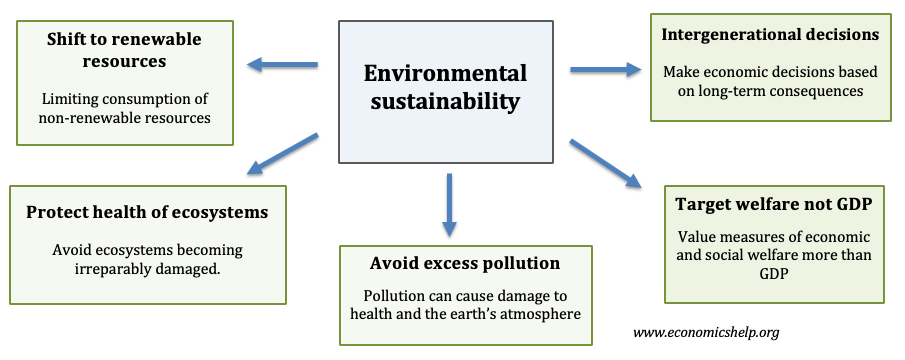
Fairness also matters between generations. Decisions made today can shape the environmental conditions and public finances inherited by people in the future. Policies that consider long-term costs alongside immediate economic gains can help avoid passing avoidable risks on to them.
Measuring progress
Gross domestic product (GDP) is a useful measure of economic activity, but it does not show the full picture. It does not, on its own, reveal how income is distributed, whether natural resources are being depleted or how healthy and secure people feel. Governments and organisations can complement GDP with measures of emissions, resource use, biodiversity, health, income distribution and access to essential services.
Good measurement helps decision-makers identify whether growth is improving people’s lives without pushing environmental pressures beyond sustainable limits. It can also help businesses understand risks and investors compare the long-term resilience of different projects.
Looking ahead
Economic growth and environmental sustainability need not be opposing goals, but aligning them takes deliberate choices. Investment, regulation, innovation and public participation all have a role to play. By accounting for environmental limits, sharing the benefits of change and judging success by more than output alone, societies can build economies that are productive, resilient and better able to support people and nature.
7 Tips for Economic Growth and Environmental Sustainability
- Invest in renewable energy to create jobs and cut emissions.
- Improve public transport to support growth and reduce car use.
- Help businesses adopt energy-efficient technology.
- Protect natural resources that economies depend on.
- Train workers for green industries.
- Use clear standards to encourage sustainable investment.
- Measure growth alongside emissions and wellbeing.
Invest in renewable energy to create jobs and cut emissions.
Investing in renewable energy can support economic growth while helping to protect the environment. Developing wind, solar and other clean power sources creates jobs in construction, engineering, maintenance and research, while reducing reliance on fossil fuels. As renewable technologies become more efficient and widely available, they can also help cut greenhouse gas emissions and strengthen energy security.
Improve public transport to support growth and reduce car use.
Improving public transport can support economic growth by making it easier for people to reach jobs, education and local businesses. Frequent, reliable and affordable buses and trains can reduce dependence on private cars, helping to ease congestion, cut air pollution and lower greenhouse gas emissions. Investment in accessible public transport can also create jobs and encourage more vibrant town centres, while walking and cycling links make journeys healthier and more sustainable.
Help businesses adopt energy-efficient technology.
Helping businesses adopt energy-efficient technology can reduce energy use, lower operating costs and cut greenhouse gas emissions. Support such as grants, affordable finance and practical advice can make improvements—like efficient lighting, upgraded heating systems and modern machinery—more accessible, particularly for small businesses. These investments can also improve productivity and resilience, showing how environmental action can support long-term economic growth.
Protect natural resources that economies depend on.
Protecting natural resources is essential to lasting economic growth because businesses and communities depend on clean water, fertile soil, healthy forests and thriving ecosystems. Using these resources responsibly, reducing waste and restoring damaged environments can help secure reliable supplies, protect jobs and livelihoods, and reduce the costs of pollution and environmental damage. By valuing nature in economic decisions, we can support prosperity today without undermining the resources future generations will need.
Train workers for green industries.
Training workers for green industries helps ensure that the shift to a more sustainable economy creates opportunities for people as well as environmental benefits. Courses and apprenticeships in areas such as renewable energy, energy-efficient construction, public transport and sustainable manufacturing can equip workers with skills that employers need. Providing accessible training and support for people moving from high-emission sectors can also help communities share in the benefits of economic change.
Use clear standards to encourage sustainable investment.
Clear, consistent standards can help direct investment towards projects that deliver lasting economic and environmental benefits. By setting transparent criteria for areas such as emissions, energy efficiency and nature protection, governments and regulators make it easier for investors to compare opportunities and identify credible sustainable projects. Strong standards can also reduce greenwashing and give businesses greater certainty when planning long-term investments.
Measure growth alongside emissions and wellbeing.
Measuring economic growth alongside emissions and wellbeing gives a fuller picture of progress than GDP alone. Tracking greenhouse gas emissions shows whether prosperity is being achieved at an environmental cost, while measures such as health, income security and quality of life reveal how growth affects people. Together, these indicators help governments and businesses make better-informed decisions and encourage development that benefits communities while reducing pressure on the climate.